A custom CRM designed to check the deal before the quote goes out.
Grand Mizban General Trading is a trading company in Dubai, where I'm Executive Director. We're developing its CRM as a custom system. The first build is running in a test environment. It isn't in daily use yet, so this page covers what has been built, how it's meant to work, and what still has to pass. It has no results yet.

Where it stands
Dates are when each step happened. Nothing here describes live use.
- 10 October 2026: build, not buy. We decided on a custom CRM for Grand Mizban rather than adapting an off-the-shelf package, because the data model of trading (requirements, supplier offers, margin before the quote) is the whole point.
- Mid-October 2026: scope agreed. The scope runs from lead to sales order. It covers lead capture, duplicate checks, customer requirements, supplier offers, sourcing requests, opportunities with costing and margin, quotations, sales orders, purchasing and payments, profitability, master data, user roles and an audit log, in English and Persian.
- 24 October 2026: first build in a test environment. The module structure for the whole flow is in place. It hasn't been tested with data yet.
- 28 October 2026: build reviewed against the scope. We checked the first build against the agreed scope, item by item, and wrote the acceptance test it has to pass before it goes live (see below).
What's in the first build
As observed in the test environment at the 28 October 2026 review. "In place" means the screens and structure exist; it doesn't mean the workflow has been proven with real data.
Working in the test build
- English and Persian. The interface switches language at any time, and the layout mirrors to right-to-left for Persian.
- Users, roles and an audit log. Sign-in, user roles (a single administrator role so far) and a log that records activity.
In place, not yet tested with data
- The sales side: leads (with a channel for each source), customers, customer requirements, opportunities moving through pipeline stages, quotations, sales orders and customer payments.
- The supply side: suppliers, supplier offers, sourcing requests and RFQs, and purchase orders.
- Master data: products, brands, categories, units and lead sources.
- Reporting: profitability, repeat buying and a KPI dashboard (all at zero until real data goes in).
Not built yet: the WhatsApp connection, AI assistance (switched off), and integrations with other systems.
The data model: Product ≠ Supplier Offer
The design choice the rest depends on: products and supplier offers are separate records.
- Product: what is being sold, organised by category and brand. It doesn't change when a price does.
- Supplier offer: who will sell it, and on what terms: price, minimum order quantity, supply terms, payment terms and delivery time.
One product can have many offers, from different suppliers at different times. When there's no valid offer for a customer's requirement, a sourcing request opens, and the validated offer comes back into the sales cycle. The aim is that prices live on offers, not on products, so an outdated price can't quietly end up in a quote.
Before and after
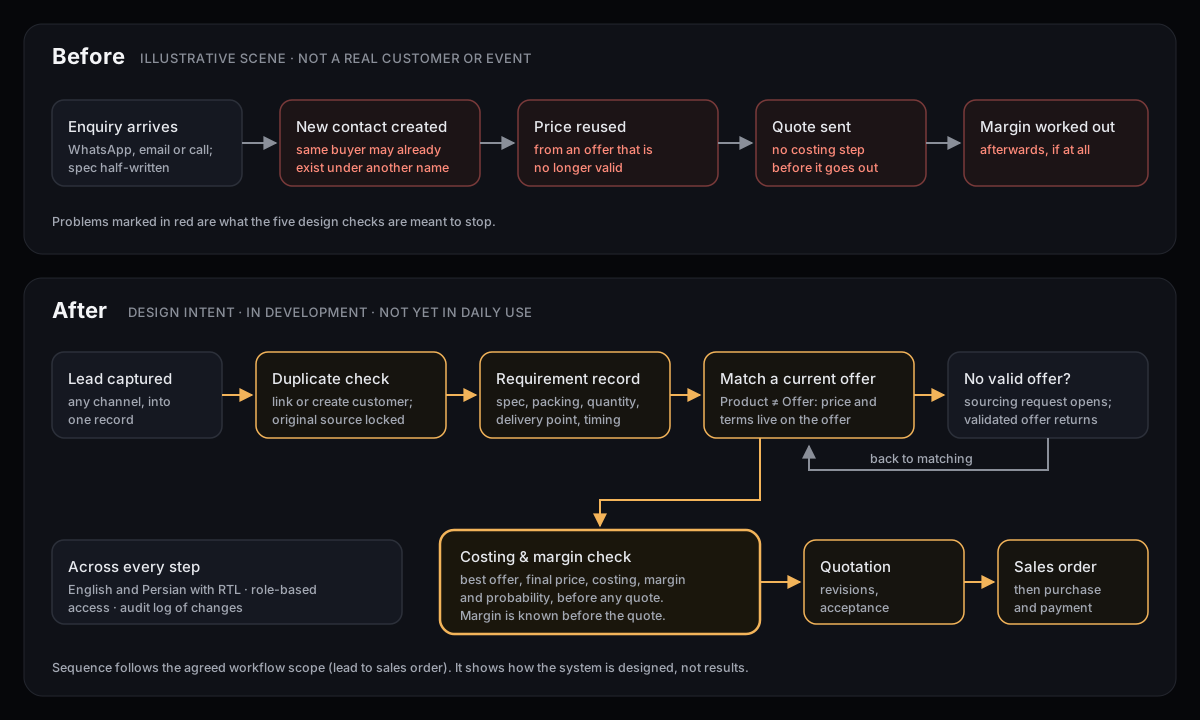
Five checks, and what goes wrong without them
Design intent, not a description of a working system.
- Duplicate check.
Without it: the same buyer ends up in two records. Designed to: every new lead is reviewed against existing customers, then linked to the existing record or created as new. - Locked source.
Without it: nobody can say where a customer came from. Designed to: a new customer's original source and creation date are recorded and locked in the workflow. - Terms on the offer.
Without it: a price stored on the product outlives the offer behind it. Designed to: price, minimum order quantity, supply terms, payment terms and delivery time are evaluated per supplier offer, with products and offers as separate entities. I lean towards keeping terms off the product. With no valid offer, a sourcing request opens, and the validated offer returns to the sales cycle. - Margin before the quote.
Without it: margin gets worked out after the fact. Designed to: the opportunity stage covers best offer, final price, costing, margin and probability. Quotation, revisions, acceptance and sales order come after. - Two languages.
Designed to: English and Persian, with automatic left-to-right and right-to-left layout, and entered data stored as typed.
Role-based access and an audit log are also in scope.
How we'll know it works: the acceptance test
Before the CRM goes live, one deal has to run end to end with sample data (no real customers):
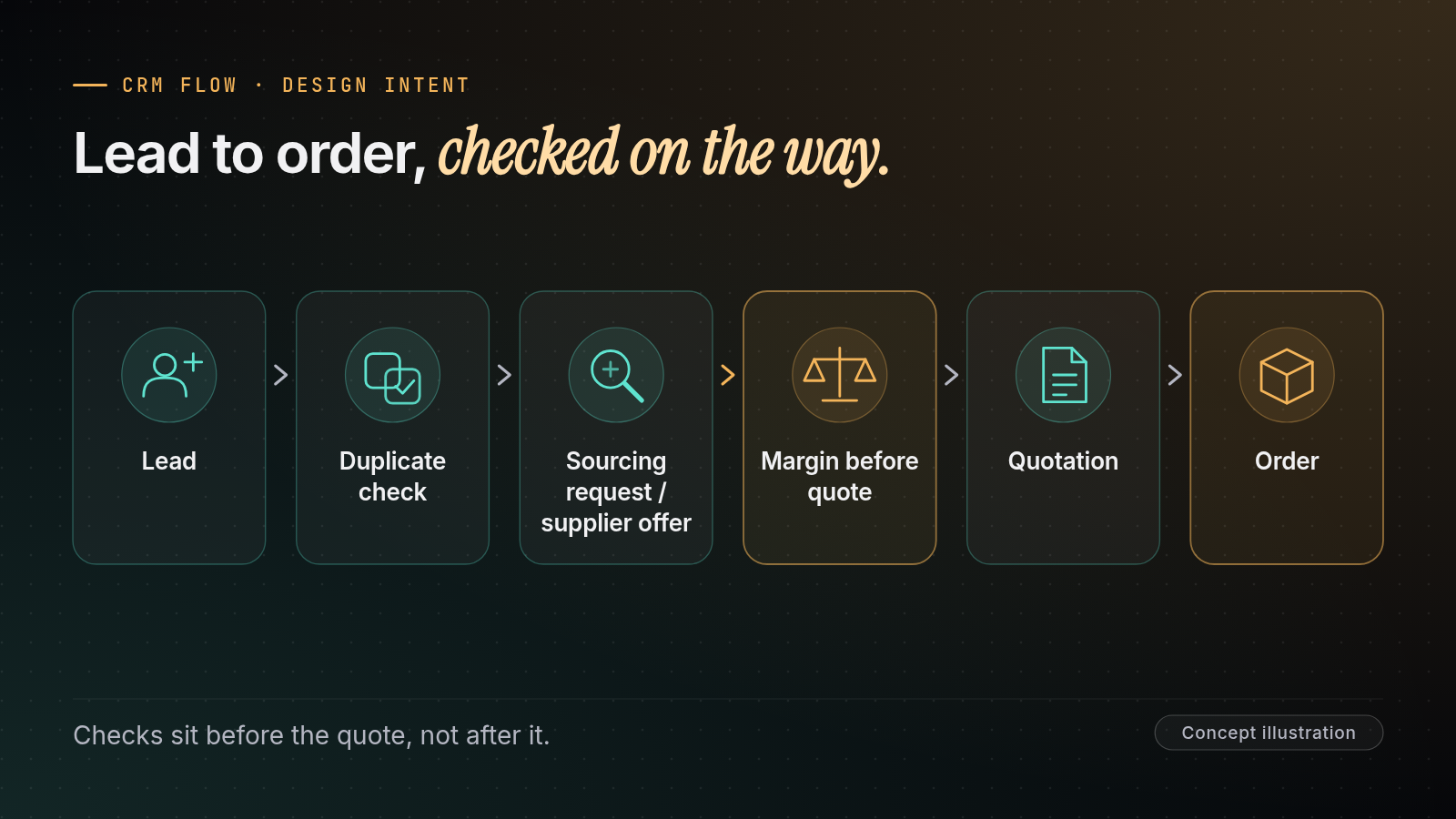
lead in (entered by hand and from a channel) → duplicate check → new or existing customer, with the source locked → requirement → supplier offer, or a sourcing request → opportunity with costing and margin → quotation → sales order → payment recorded → profitability report.
The same test also checks the language switch, roles, the audit log, and that a backup can be restored.
What's next
| Step | Status |
|---|---|
| Run the end-to-end acceptance test above with sample data | Next |
| Move the system onto hosting in the company's own account | Decision pending |
| Connect WhatsApp, and add an agent register | Not in the first build |
| Switch on AI assistance, behind human approval | Later |
| Add day-to-day use, results and lessons to this page | When verified |
What I've learned so far
- Write the acceptance test before you sign off a stage. "The workflow works" means nothing until it's one named scenario, with data, that either passes or fails.
- A full module list isn't a working system. The first build had a screen for almost everything, and none of it had been run with a real deal yet. The review turned "looks complete" into a list of what's proven and what isn't.
- Own the infrastructure from day one. The hosting account, the domain and the backups should belong to the business, with the builder given a named user.
A note on AI
Separate from the project, and not a claim about this CRM: a principle I work by in my own work, including MoMo OS. AI prepares, a person approves.
Outcome
Results, day-to-day use and what I'd change: to be added when verified.
What's next
Let's map what your business can hand to agents.
30 minutes. Your workflows, what to automate first, and where a person must stay in charge.
Book a call