The default CRM pipeline finishes at “Closed won”. For a trading company, that’s the wrong place to stop.
A trading company doesn’t make money when a deal closes. It makes money when the goods have been delivered and paid for, at a margin that survived freight, terms and the supplier’s last-minute changes. The best case is that the same buyer comes back. A CRM that counts leads and closed deals measures how busy you are. It doesn’t tell you whether you’re building a business.
I’ve spent years in high-velocity CRM and growth, and later led FMCG and commercial growth at Amer Trading Food. Today I’m Executive Director at Grand Mizban General Trading, and the trading system we’re designing there rests on one principle: in trading, the lead is not the thing to optimise. Margin is.
This article is that principle as a general framework. It isn’t a case study and it carries no company data. It’s the set of design rules I’d use for any trading business, whatever software it ends up on.
Why a standard CRM pipeline fits trading badly
The standard CRM pipeline assumes one shape of business: one customer, one deal, one product, one price, signed once. That works for software and services. Trading has a different shape:
- The buyer asks for a requirement, not a SKU. Spec, grade, packing, delivery point, timing. The same requirement can be met by several products.
- Every product has several offers. Different suppliers, prices, terms, minimum order quantities and validity dates, and they change.
- Margin is decided before the quote, not after the deal. By the time a deal is “won”, the price is already promised.
- The money is in repeat business. A one-off order at a thin margin can cost more in attention than it earns.
People running wholesale and distribution businesses say the same in public. One owner on Reddit asked for a CRM that connects “suppliers, products, and customers” (r/CRMSoftware). In another thread, one distributor put it bluntly: “Most general CRMs are built around a deal-pipeline model, which isn’t how distributor sales actually work” (r/CRMSoftware).
Search shows the same gap. In the Google UAE results I pulled on 11 Oct 2026 for “crm for trading companies”, the top six organic results mixed CRMs for online-trading brokers, CRMs for trade contractors and service businesses, and a forum thread. Two were about a business that buys and sells goods, and both were vendor pages. That’s useful once you know what you need. This article is about working out what you need.
The margin-first flow
Here’s the margin-first flow, simplified:
Lead → Requirement → Offer match (or sourcing request) → Margin check → Quotation → Order & purchase → Delivered & paid → Repeat purchase
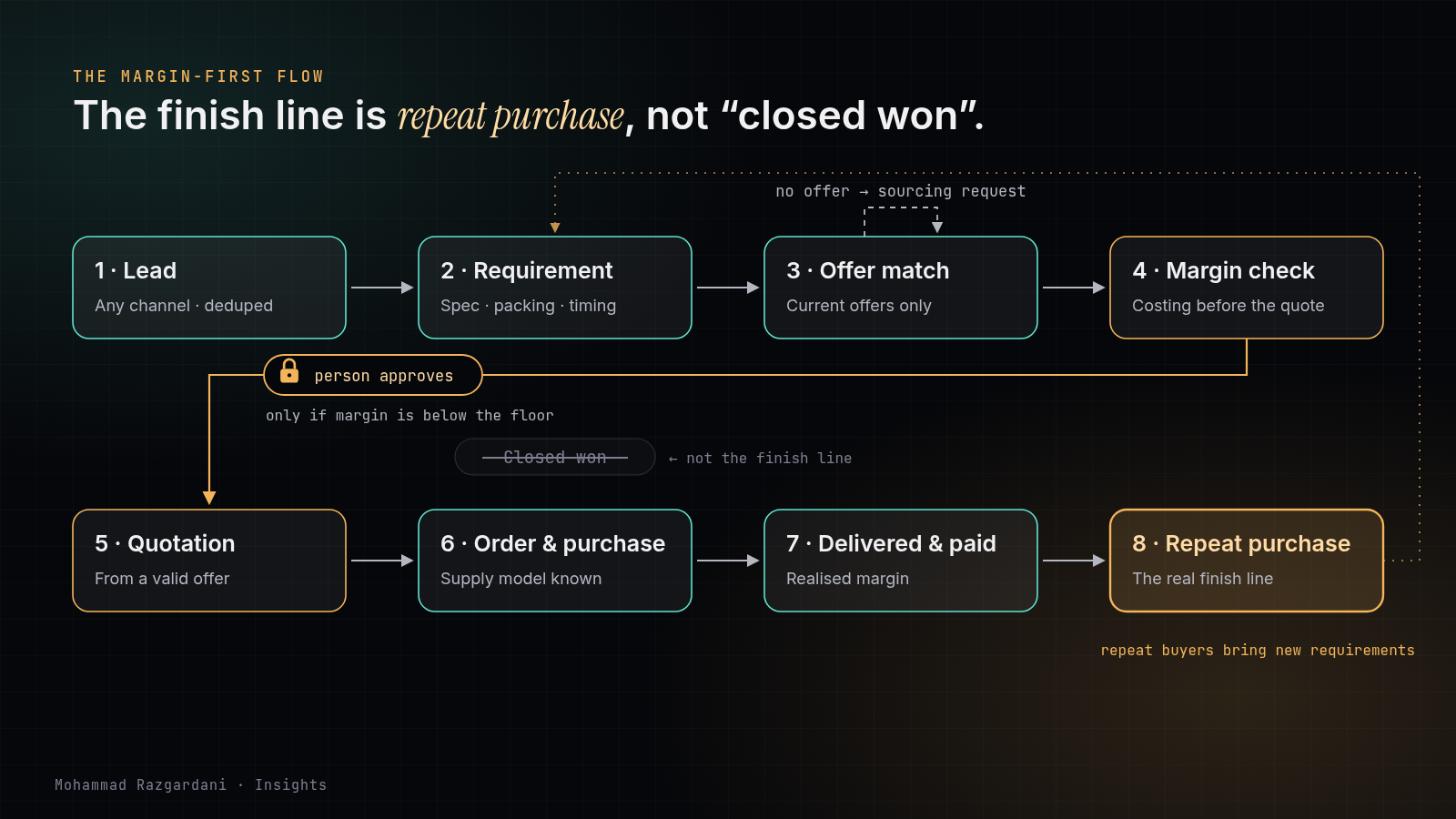
Five design rules make this flow work. They apply whatever system you end up using.
Rule 1: The requirement is its own record
What the buyer needs is separate from who the buyer is. A contact record says “this company, this person, this phone number”. A requirement record says “this product type, this spec, this packing, delivered here, by then, on these payment terms”.
Why it matters:
- One buyer can have several open requirements, each moving at its own speed.
- A requirement you can’t fill today is still valuable data. It tells you what to source.
- You can measure demand by requirement, not by number of contacts.
If your CRM keeps the buyer’s need as a line in the notes field, you can’t search it, match it or report on it.
Rule 2: Product ≠ Offer
This is the rule I’d put at the core of any trading system.
- A Product is what something is, and it doesn’t change: origin, grade, specification, packing.
- An Offer is who will sell it, on what terms, until when: price, currency, incoterm, minimum order quantity, available quantity, payment terms, lead time and an expiry date.
One product can have many offers from different suppliers at different times. If you store price and stock on the product, every expired price and every sold-out quantity stays in your system, and sooner or later in a quote.
Illustration, with any bulk commodity: the Product record holds origin, grade, spec and packing. Each supplier’s Offer holds price, port, MOQ and validity. When an offer expires, it drops out of matching automatically and the product stays. Supplier cost and margin never sit on a record a customer can see.
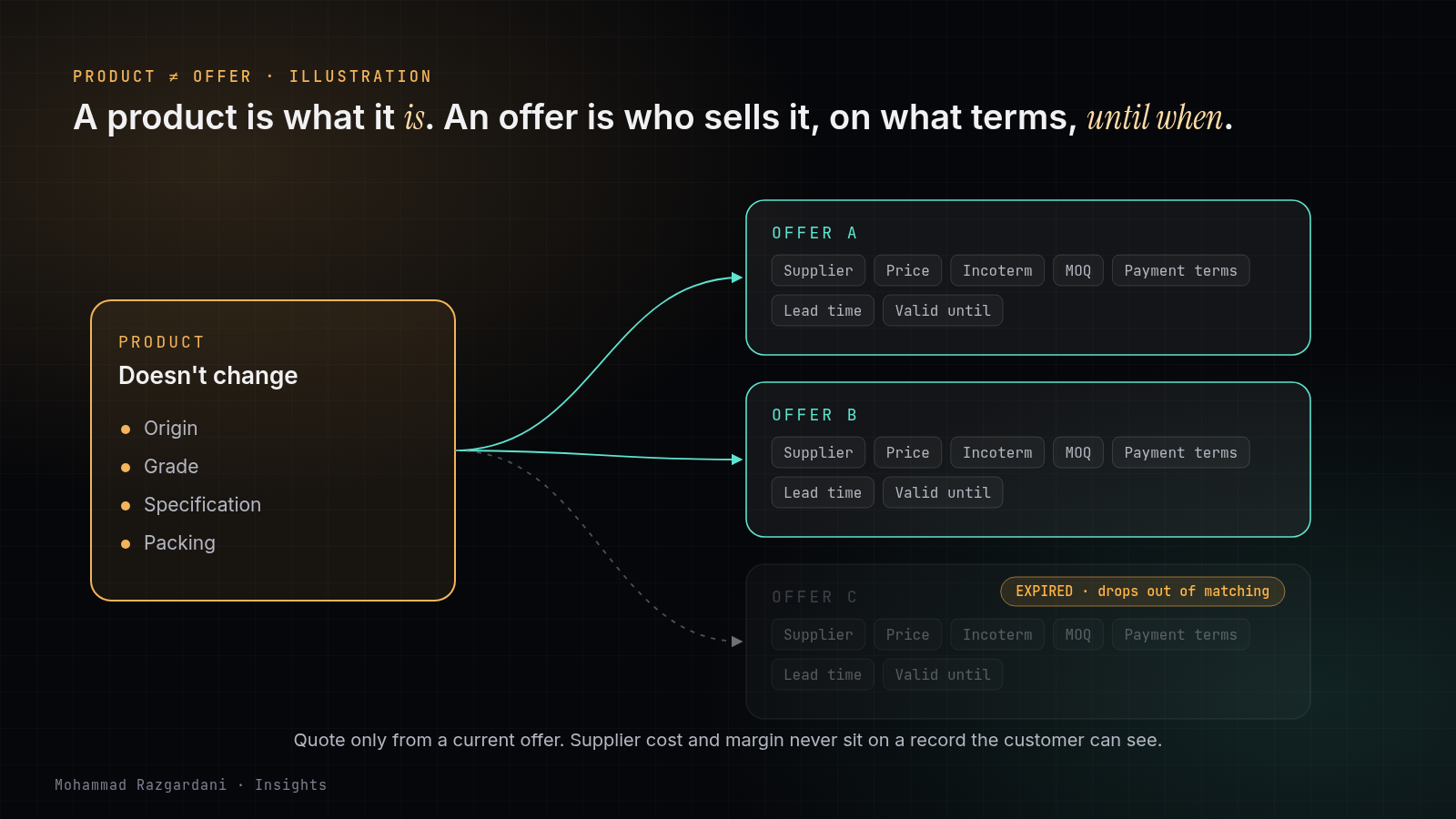
It sounds like a database detail. It’s really a trust decision: you only ever quote from a current offer.
Rule 3: The system must know which supply model each deal is on
More range doesn’t have to mean more stock. One trading business can run four supply models, and the trading system we’re designing at Grand Mizban General Trading is being built to support all four. Each one changes the cash, the risk and the margin you should expect:
| Supply model | What it means | What the CRM needs to know |
|---|---|---|
| Own Stock | You sell from your own warehouse | Available stock; the working capital tied up in it |
| Supplier Stock | You sell against a supplier’s stock without bringing it in | How current the supplier’s availability is |
| Back-to-Back | You buy only after the customer order is confirmed | Whether timing and terms line up on both sides |
| Sourcing on Demand | The buyer asks for something you have no active offer for | A sourcing request, owner and deadline |
The point isn’t to pick one. It’s to tag each deal with its model, because cash, risk, margin and the right next step all depend on it. And when there’s no matching offer, the requirement becomes a sourcing request instead of a dead end. Every request grows your supplier base from real demand. That’s why I think asset-light trading is less a capital problem than a systems problem.
Rule 4: No quotation without a margin check
Costing, margin and payment terms are checked on the opportunity before the quote goes out, not reconstructed after the deal.
A useful costing line on an opportunity carries, at minimum:
- the offer it’s based on (and that offer’s validity date)
- product cost and currency
- freight and logistics to the agreed delivery point
- duties, clearance and other landed-cost items where they apply
- the cost of the payment terms you’re giving (time is money in trade)
- the resulting margin, and whether it clears your floor
If the margin doesn’t clear the floor, the quote doesn’t go out without a person deciding it should. This is the same gate logic I use for AI agents: the quote is the irreversible step, so that’s where the human sits. I’ve written about where the human approval gate goes for agents more generally.
Rule 5: Dedupe first, and lock the original source
Leads arrive from many directions: website, WhatsApp, Instagram, email, referrals, events, direct outreach. Two rules keep the data honest:
- Dedupe before anything else. The same buyer arriving by WhatsApp and email is one buyer, not two leads.
- Lock the original source. Once recorded, the first source can’t be quietly rewritten. Otherwise marketing attribution turns into an argument, and you lose the one thing performance marketing needs: knowing which channel brings margin, not just leads.
What to measure instead of lead count
A margin-first CRM changes the dashboard. These are the measures I’d put at the top. They’re definitions, not targets or results:
- Requirements with a matching current offer. Can you actually serve the demand you’re getting?
- Quoted margin vs realised margin, per deal. Where does margin leak between the quote and payment?
- Quotes issued on expired or soon-to-expire offers. This should be zero, and the system should make it hard.
- Sourcing requests that became supplier offers. Is your supply side learning from demand?
- Repeat buyers, and margin from repeat business. The real finish line.
Lead count can stay on the dashboard, just not at the top.
Where AI agents fit, and where they don’t
A margin-first CRM is a good home for AI agents, because the records are explicit. In the flow above, agents can:
- pull a structured requirement out of a WhatsApp message or email and ask for missing specs
- suggest which current offers match a requirement
- flag offers about to expire on open opportunities
- draft follow-ups and quotations for a person to review
- dedupe incoming leads and keep the source locked
What they shouldn’t do is confirm a price, send a quote, accept terms or promise availability on their own. Those are commitments. An agent may say “unknown”. It may not hit send.
10 questions to ask before you choose a CRM for a trading company
Use these with any vendor or builder, before you look at a demo:
- Can a buyer’s requirement be its own record, separate from the contact?
- Are products and offers separate, with many offers per product?
- Do offers carry a validity date and drop out of matching when they expire?
- Can each deal carry a supply model, and does that change what’s required next?
- Does a missing offer create a sourcing request with an owner?
- Is costing and margin on the opportunity, before the quotation?
- Can you set a margin floor that needs a person’s approval to go below?
- Is the original lead source locked, with an audit log of changes?
- Can it report realised margin and repeat purchase, not only won deals?
- Which actions can automation or AI take alone, and which require approval?
If a system can’t do most of these out of the box, you’re choosing between configuring it heavily, building around it, or building your own. All three can be right. Only the questions tell you which.
What doesn’t work yet
The design has costs, and I’d rather name them:
- It’s a framework, not a case study. The trading system we’re designing on these rules isn’t live yet, so there are no results to report.
- Offers need upkeep. Validity dates only help if someone keeps offers current. Data discipline is the price of quoting honestly.
- A margin check adds a step. When a buyer wants a price in minutes, a costing step can feel slow. The answer is making costing fast, not skipping it.
- Adoption is the real risk. A sales team used to quoting from memory and WhatsApp won’t change because the data model is elegant. The system has to save them time on day one.
What’s the last stage in your CRM: “Closed won”, or something after it? I’d like to hear how other trading teams draw their finish line.
If you’re mapping a CRM for trading companies, start with the ten questions above. They’re the same ones I’d ask of any system, including the trading system we’re designing.
About the author: Mohammad Razgardani (MoMo) is a Dubai-based business strategist working on AI and automation for FMCG and B2B trade. He is Founder & CEO of Helper Trade, his UAE trading and export brand, and Executive Director of Grand Mizban General Trading. He was previously Head of FMCG & Commercial Growth at Amer Trading Food.
Questions
What is a CRM in a trading company?
It's the system that carries a deal from the first inquiry to profit and repeat purchase. In trading it has to hold more than contacts and deals: the buyer's actual requirement, the supplier offers that could meet it, the costing and margin, and whether the buyer comes back.
Which CRM is best for a trading company?
The one whose data model fits trading. Before comparing brands, check whether it keeps products and supplier offers apart, stores the buyer's requirement as its own record, checks margin before a quote, and reports realised margin and repeat purchase rather than lead counts.
What CRM software is best for distributors?
Distributors mostly sell a known catalogue to existing accounts, so look for account health, reorder reminders and price lists per customer. If you also source per requirement, you need the trading features too: offers with validity dates and a margin check before each quote.
Which CRM is best for B2B sales?
For B2B, judge a CRM by how it handles long, multi-person deals and what it counts as success. A good B2B CRM tracks requirements and quotes, not just contacts, and reports revenue and margin per account, not only deals won.
Should a small trading company start on an entry-level CRM plan?
It can, as long as you test the data model first. The cost usually appears later, when you need custom records for requirements, offers and costing. Check that a basic plan can hold those records before you commit.
Does a general trading LLC in the UAE need a CRM or an ERP?
Usually both eventually, for different jobs. The ERP or accounting system owns stock, invoices and VAT. The CRM owns the commercial side: inquiries, requirements, offers, quotes, follow-up and repeat business. What matters is that margin data flows between them.