
My AI agents are allowed to say “unknown”. They are not allowed to hit send.
That one rule is the centre of how I work with AI. I run my work with a team of AI agents: at Helper Trade, my own UAE trading and export company, and at Grand Mizban General Trading, where I’m Executive Director. They research, draft, tag, summarise and prepare. Nothing they prepare reaches a customer, a supplier or the public unless I’ve approved it, or approved the exact information it’s built from.
That puts me in the middle of a question a lot of UAE businesses are now asking. The UAE is deploying AI agents fast. In a Dataiku and Harris Poll survey reported in October 2026, 62% of UAE CIOs estimated that their organisation has more than 50 AI agents running in production. Only 5% said they could reliably identify and contain a problematic agent across environments within one to two hours (The National). Dubai has also set its private sector a two-year push toward agentic AI (Dubai Media Office).
Adoption is moving faster than control. This article is about control at the level of one business: where to put the human, and where not to.
What “human in the loop” actually means for a business
In AI-agent terms, human in the loop means the agent stops at a defined point. A named person then approves, edits or rejects the next action before it runs.
Its sibling is human on the loop. There, the agent acts and a person watches, ready to step in after the fact.
Neither is better in general. They fit different actions:
- In the loop (approve first) suits anything irreversible or visible outside the business.
- On the loop (monitor, intervene later) suits reversible internal work.
A common mistake is applying one of them to a whole workflow. Either everything needs a click and the agent turns into a slow drafting tool, or nothing does and the business carries risk it never chose.
Ask about actions, not autonomy
“How autonomous should our agent be?” has no useful answer. A better question: which actions in this workflow can be undone, and which ones commit us to someone outside?
The workflows I design break down into the same four kinds of action. I think of them as a ladder:
| Rung | Action type | Example in a trading business | Gate |
|---|---|---|---|
| 1 | Read & summarise | Summarise a buyer’s message, extract the product they asked about | None. Log it. |
| 2 | Draft & prepare | Draft a reply, prepare a quotation, write an internal note | None to create. The draft is not the action. |
| 3 | Change internal records | Update a lead’s status, tag a deal’s supply model, add a research record | Spot-check, plus an audit log |
| 4 | Commit outside the business | Send a message, send a quote, confirm a price, pay, publish, sign | A person approves first |
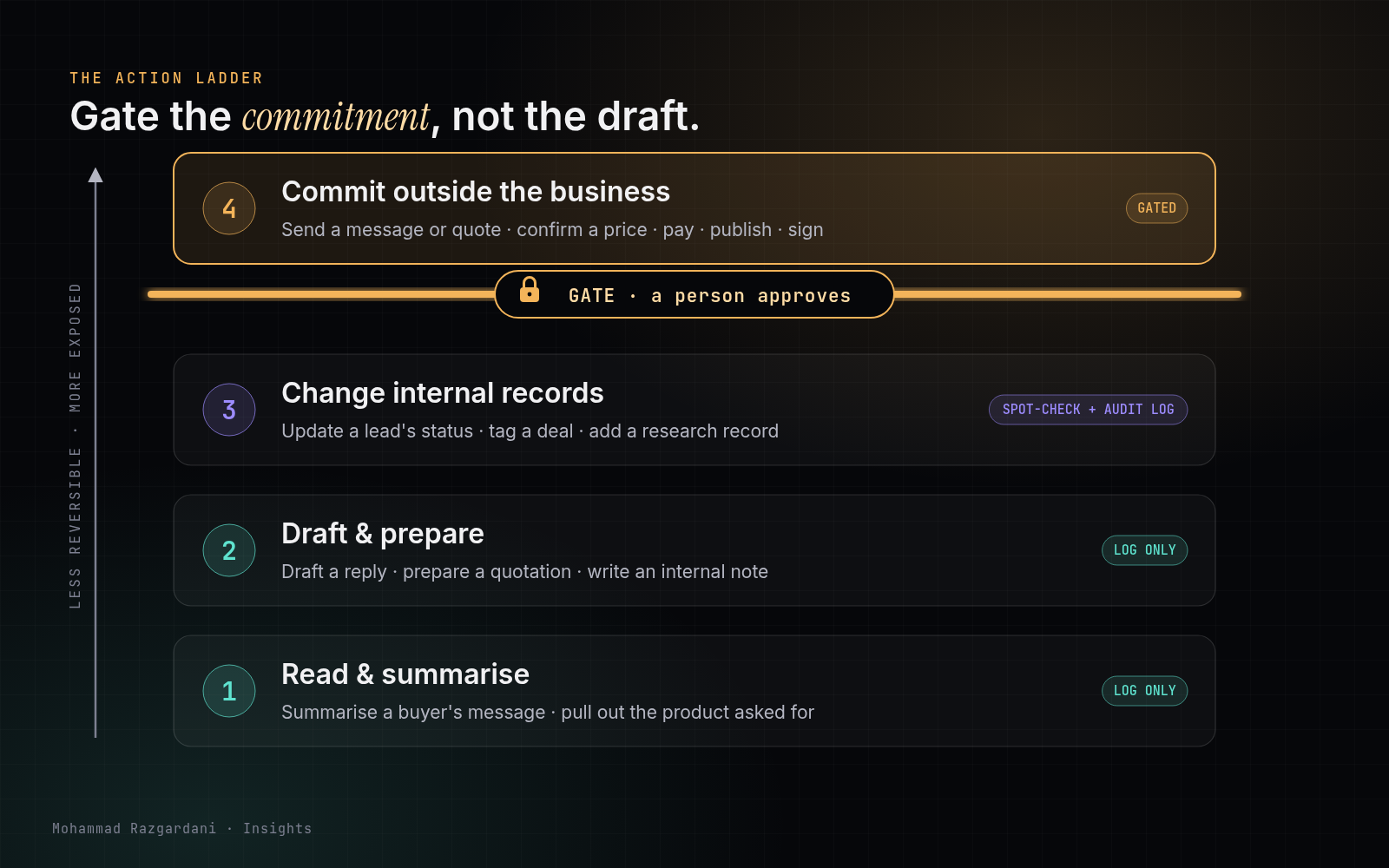
The gate goes before rung 4, not before rung 2. An agent that drafts a quote has done nothing irreversible. An agent that sends one has made a promise.
To place any single action on the ladder, I use three tests:
- Can it be undone cheaply? A wrong tag can be fixed in seconds. A wrong price sent to a buyer can’t.
- Will someone outside the business see it? Customers, suppliers, the public, a government portal.
- Does it move money or create an obligation? Spending, discounting, quoting, accepting terms.
A “yes” to any of the three moves the action up the ladder. A “yes” to the second or third puts it behind the gate. A fourth question settles the borderline cases: are the agent’s sources solid? If an agent can’t point to where a fact came from, it can prepare but not decide.
How I run this: MoMo OS
I call the system my agents work in MoMo OS. To be clear about its age: I started it in October 2026. It’s new, and I’m not claiming results yet. What I can share is the design. Each rule exists to make the gate work.
One source of truth. The agents work from a small set of living documents: projects, this week’s priorities, a task queue, a waiting-for list, a decision log, a weekly review. If something exists only in a chat, it doesn’t exist. This matters for approvals: when I approve something, I’m approving against the same facts the agent used.
Every claim carries a tag. Each statement an agent writes is marked Confirmed (with the source file), Assumed or Proposed. An agent that can’t cite a source has to write “assumed”. When a draft reaches me for approval, guessing is visible at a glance. Reviewing 20 lines where 2 are tagged Assumed is a very different job from reviewing 20 lines that all sound equally confident.
The decision log never deletes. Decisions are added or superseded, never erased. A month from now I want to know why we approved something, not only that we did.
A weekly rhythm. It’s new too: Monday scorecard, Wednesday decision checkpoint, Friday status. The agents batch their questions instead of pinging me all day. This is my main defence against approval fatigue, which I come back to below.
One hard rule. Nothing that commits a business goes out without me. No offer, no discount, no contract. Agents do the desk work. I keep the commitments. (The one designed exception, simple support answers built only from information I’ve approved in advance, is further down.)
What this looked like in practice. In October 2026 one of my agents prepared a LinkedIn post that stated my rules, including “nothing an agent prepares goes out without me”. A day earlier I had approved Helper’s WhatsApp pilot to send simple, pre-approved answers on its own, so that sentence was no longer true. A second agent caught the conflict while checking the draft against the decision log. It didn’t quietly rewrite the post. It sent me the conflict, the evidence and a corrected wording as one approval request. I approved the new rule, it was logged as superseding the old one, and only then was the post changed. That’s the system doing its job: the facts agree, the conflict is visible, and the decision stays with me.
What a good approval request looks like
A gate is only as good as the request that reaches the human. If I need to open three documents to understand what I’m approving, I’ll either take too long or approve without reading. Both are failures.
Here’s the checklist I hold every approval request to:
- [ ] The action, in one line: “Send quotation”, “Publish post”, “Confirm supplier booking”.
- [ ] The exact content, as it will go out. Not a summary of it.
- [ ] Who receives it or where it appears.
- [ ] Sources, with each key fact tagged Confirmed, Assumed or Proposed.
- [ ] What’s unknown, stated plainly (“lead time: unknown”).
- [ ] Is it reversible? Yes or no, and what undoing it would take.
- [ ] What happens after approval: the next automatic step, if any.
- [ ] Two buttons: Approve, or Return with a note. “Return” must be as easy as “Approve”.
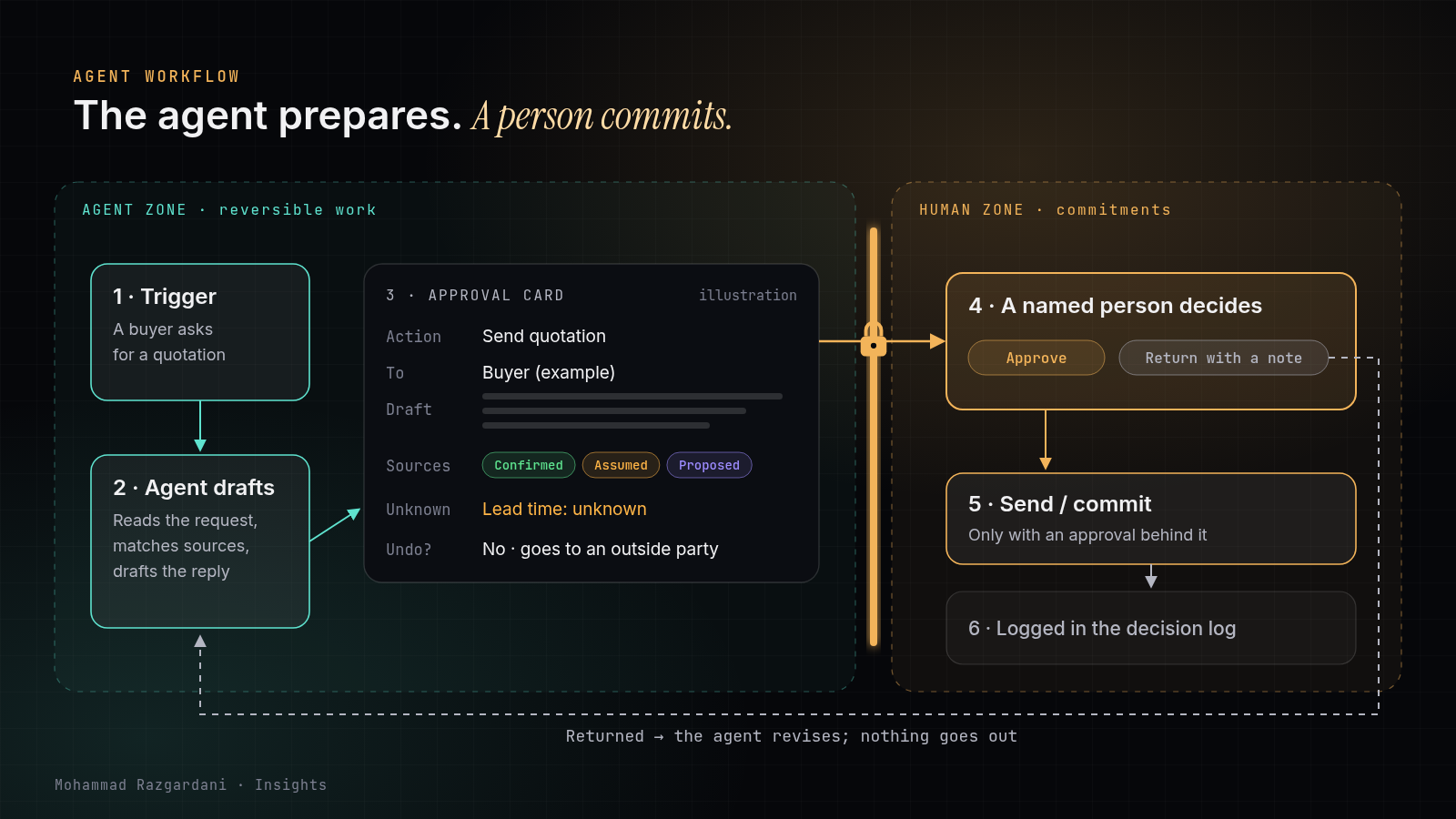
The approval card in the middle is an illustration, not a real system.
Illustration. A buyer asks for a quotation on a product. The agent drafts the reply. It attaches the current supplier offer (Confirmed, with its validity date), the costing (Confirmed) and the delivery timing (Assumed: no written confirmation from the supplier). The approval card shows all three tags. The Assumed tag tells me exactly which line to check before I approve, or tells me to return it with “confirm lead time first”. It becomes a quick check instead of a full re-read, because the agent did the sorting.
A pilot: pre-approved answers on WhatsApp
There’s one place where something I run does talk to customers without me clicking “approve” each time: Helper’s AI support agent on WhatsApp, a pilot since October 2026. It looks like a contradiction. It isn’t.
The agent answers simple questions only from information I’ve already approved. The approval moved from the message to the information: I approve a line once, and the agent may use it many times. Anything outside those lines goes back to the gate. On WhatsApp, discounts, prices we haven’t approved, complaints and commercial promises are escalated to my phone, and I answer them myself.
It started in October 2026 and is still a pilot, so this is a design, not a track record. I explain the setup in my article on WhatsApp AI agents for UAE businesses.
What doesn’t work yet
Gates have costs. These are the ones I’m watching:
- I’m the bottleneck by design. One person approving everything means the system moves at that person’s speed. The weekly rhythm and batching help. A clean approval card helps more. But at some point specific action types will need to be delegated to other named people, not to agents.
- Rubber-stamping. After the twentieth good draft, it’s tempting to approve the twenty-first without reading. Evidence tags push back on this, because they point at the lines that deserve attention. They don’t remove the temptation.
- Gates written in prose leak. Rules that live only in a prompt can be ignored or misread by the model. The stronger version puts the gate in the permissions, so a protected action simply fails without an approval behind it. Where a setup doesn’t work that way yet, part of the gate depends on discipline.
- It’s early. MoMo OS is new. I’ll write up what holds and what breaks once there’s something real to report.
When to loosen a gate
Trust should grow by action type, not by workflow. A sensible order:
- Frequent, low-consequence and reversible: automate from the start, and log it.
- Easy to detect and easy to reverse: automate once the agent has a clean record on that specific action.
- Possible failure that nobody would notice: keep a named owner and monitoring, even when it’s automated.
- Creates a commitment or moves money: keep the gate. Don’t graduate these because the agent has been good lately.
Start this week: a 9-step checklist
- Pick one workflow, such as inbound inquiries, quotations or supplier follow-up.
- List every action in it, including the small ones.
- Place each action on the ladder using the three tests.
- Write the “may not” list before the “should” list. What is the agent forbidden to do?
- Make “unknown” an allowed answer, and make blank mean unknown, not zero.
- Design the approval card (checklist above) before you design the agent.
- Set a fixed rhythm for approvals so the gate doesn’t turn into a constant interruption.
- Keep “finished” and “approved” as two different states, with two different words. A model completing a task approves nothing.
- Put the gate in the permissions, not only in the instructions: a send, payment or publish without an approval behind it should fail.
If you’re designing AI agents for business, the gate is the part worth getting right first. The rest is easier to change later. You can see how MoMo OS works, or get a rough first read on what your business could automate. Trading companies have a version of this problem inside the CRM, which I cover in my article on CRM for trading companies.
Questions
What is a human-in-the-loop approach to AI?
It means an AI system pauses at a defined point and a named person reviews, approves, edits or rejects the next step before it happens. In a business, that point should be the action that creates an outside commitment: sending, quoting, paying, publishing or signing.
What is human-in-the-loop authorization for AI agents?
It is an approval the agent needs before it may run a protected action. The strongest version lives in the permissions, not the prompt: a send, payment or publish without an approval behind it simply fails.
How can I build an AI agent with a human in the loop?
List every action in one workflow, sort them by how reversible and how visible outside the business they are, and put an approval step in front of the top tier only. Design the approval request first: the action, the exact content, the sources and what is unknown.
What is the difference between human in the loop and human on the loop?
In the loop, a person approves before the action runs. On the loop, the agent acts and a person monitors and can step in afterwards. Use in-the-loop for irreversible or external actions, and on-the-loop for reversible internal work such as summaries, tagging and drafts.
What can AI agents do for my business?
They can read and summarise messages, research, draft replies and quotations, update records and route work. They can also send, pay or publish if you let them, which is why the useful question is which of those actions they may take alone.
Why is human in the loop important?
Because the risk of an agent sits mostly in what it does, not what it writes. A person at the irreversible step catches wrong prices, wrong recipients and made-up facts before they become commitments, while the agent still does the preparation work.